Powered by Blogger.

Flag

Free counters!

Saturday, July 21, 2012

Congratulation of RmzanTo all friends

Sunday, February 12, 2012

Study In Pakistan

Welcome to Pakistan
Welcome to Pakistan. Pakistan has always welcomed students from all over the world. Hospitality has been embedded in the nature of the people of Pakistan. You will not be a foreigner in Pakistan because a mosaic of cultures has been embedded in PAKISTANI culture.
The quality of the education and teaching staff at Pakistani Universities offers you a world of opportunities to get the skills you will need to compete in the global market.  Degrees granted by Pakistani Universities are recognized around the world. In Pakistan, students will have opportunity to experience both modernity and tradition in one of the safest and most stable countries in the region. Furthermore, in all Pakistani Universities the language of instruction is English and these universities also give opportunities to learn English. Above all, quality of education will make you ready for the future.
 Higher Education in Pakistan
Pakistani Education system is not the least bit below the international standard. In fact, Educational institutions in Pakistan are competing with international institutions and success of Pakistani medical doctors in America and increasing demand of Pakistani engineers in Middle East is a clear evident of it.
After 2001, when University Grants Commission was restructured and renamed as Higher Education Commission (HEC), the higher education in Pakistan experienced a dramatic change and progress.  HEC revised previous policies to make the educational system of Pakistan comparable to the international standards. The commission has conceived and implemented a number of programs for promotion and development of higher education in the country.
Institutions
At this time, 118 Chartered Universities and Degree awarding institutions are operating in the country with 1700 affiliated colleges.
Sr.
Legal Status
No. of institutions
Type of Institutions
1.
Chartered Institutions/Universities
124
 
2.
Affiliated Institutions
2,000+
 
3.
General Institutions
1100+
(Arts/Social Science, Natural science, Humanities etc.)
4.
Professional Institutions
1050+
(Medical Sciences, Engineering, Agriculture, Computer, Management Sciences, Commerce, Law etc.

Affiliated Colleges tends to be smaller and usually offer Undergraduate (Bachelor) degrees, whereas Chartered universities and Degree Awarding Institutions offer Undergraduate as well as Post Graduate degrees (Masters, M.Phil & Ph.D).
 
Discipline/Course
Disciplines are usually linked with Faculties. But there are different names for the same faculty in different institution. e.g one institution may have faculty with the name of arts and other may have social sciences although both are same. So we have divided the Disciplines into 9 TYPES keeping in mind the sequence and system of the institutions. Disciplines and their relevants are totally linked with these types.
 
Almost every type of discipline is being offered within Pakistan. Following table shows the number of the disciplines available in Pakistan.
 
No
Discipline
Graduate Level
Postgraduate Level
1
Agriculture
9
43
2
Computer Sciences
15
33
3
Engineering
69
80
4
General [Social/Natural Sciences]
78
173
6
Medical
12
120
7
Professional
131
190
 

eLearning in Uganda – A report from Makerere University


Makerere University is one of the oldest and most well reputed universities in East Africa. As a leading institution in the field, Makerere, or Mak (pronounced Muuk) as it’s affectionately called, has had a prolific distance learning program since the early 1990s. Much of this program followed the historical route of paper based correspondence learning until the early 2000’s.

Today, over 26,000 users traverse the Mak Moodle site each year, a site that only crashes around finals time. Like most higher education institutions, Mak’s elearning team runs the front end of their learning management system, in this case Moodle, with the IT department heading up the back end support. Mak’s Moodle supports 9 colleges and numerous projects.
But while Mak’s eLearning department is nothing to brush off as a “pilot” or “pet” project, Mr. Tito Okumu, who I met with in early February, head of the eLearning team, does have some interesting insight into challenges in eLearning in Uganda.
First, there’s the unique problem of funding sources and projects. Just like international development projects, educational projects have various funding sources in Uganda, some from international donors, some national. As a result, each project that wants to run a learning management system like Moodle, runs into the “re-creation of the wheel” syndrome, where they need their own Moodle, with their own Front page. Where does that leave Mak? With more Moodle sites running than the university knows what to do with, some with end dates, some ongoing.
Second, students at Mak are pushy! They are charged a technology fee annually and are set on seeing that fee realized in the form of online learning and access to learning materials. Makerere students have a history of striking, and strikes can quickly turn into riots. As such students have some ability to force faculty to use the Moodle system. What interested me when speaking with Mr. Okumu was that students are interested in using Moodle. He credits the technology fee that they are charged, but as a recent graduate student myself, I wonder if students are just more interested in using Moodle because they can access their readings remotely, they can check the syllabus, and they have a general understanding of what they are supposed to be doing in class just by going to a website.
Mak’s Moodle has an offline backup called “Poodle.” Poodle is almost identical to Moodle, but does not and cannot access the internet. Poodle has served the eLearning team at Mak’s purposes during the frequent power outages that make online learning a frustrating experience in Uganda.
All in all, Mr. Okumu provided valuable insight into particular challenges in eLearning in sub-Saharan Africa. As techies will, the eLearning team at Mak finds “work arounds” where they use offline content, tech trainings for faculty and many Moodles to meet the needs of the growing eLearning community in Uganda and throughout the region.

Monday, January 23, 2012

Images of Latest Technology


  • Latest Technology

    Aerostat Radar
    India has recently acquired Aerostat radars. The entire system is divided in major parts. Firstly, the aerostat balloon which has been acquired from Israel and second part is the payload on board the balloon which consists, advanced programmable radar (APR), Electronic Intelligence (ELINT), Communication Intelligence (COMINT) and V/UHF radio telephony equipment and Identification Friend or Foe (IFF). It has the capability to be integrated with AWACS and ground air defence environment and funtion as a command and control centre. Depending upon the payload the theethered balloon can be raised to the height between 10000 feet to 16000 feet.

    The system gives a seamless radar cover of 300 km plus at low level along with good RT range and requisite ELINT. The system could be termed as static AWACS. Off course it comes with some vulnerabilities and limitations, like weather, wind speeds, lightning & thunder, launch & recovery periods are vulnerabilities. Its virtues also make it a prime target for enemy therfore it needs to be protected by exclusive air defence weapons. But we hope that the advantages of such system would outlast the limitations
    Nuclear Power Plants of USA:
    The map Nuclear Power Plants of USA shows the location of each commercial power reactor that is apear  under construction, or ordered as of February  2011 this year. Information includes each reactor's generating capacity ( MWe) design type, date of commercial operation (actual) and reactor supplier.The red stars indicate the locations of 12 potential new reactor projects in which four have signed engineering, procurement, and construction contracts ,blue stars indicate the locations of five new reactor projects that have been suspended.  For all 17 projects, applications for combined construction and operating licenses have been submitted to the Nuclear Regulatory Commission’ boxed information for each project provides the plant name, the city and state of the site, the reactor model and  owner.

    ROBORT TECHNOLOGY
    Robort technology can help in human problems like damage to nuclear power in japan.  
    Also this technology help in earthquake and tsunami.japan government sent to monitor
    With cameras to sea level of water.Robort working with humans in the world.
    This robort technology first intro a labor,now this technology spread all universities and more and more devolopement in this field.
    First industrial Robort  can make in 1961 GM factory and then in 1980 its make a globle market in japan.
    Korea also devlopment in this field and make robortic vacume cleaner.

    ASIMOS ROBORT
    This ASIMOS Robort technology is new  artificial  intelligence.This Robort is desgin  as human ,and also
    Work like a human being ,this robort run 6 km/h like a sport man.This robot work all type which can perform a man.Asimos think like a human for example he feel all things which think a man ,for siting table he feel tuch them and then sit it.In this robort a software will design which can perform all activties like a human.


    LINKS:  http://technicallyphilly.com/tag/robotics
                         Through this link you can more new asimos robort technology
                         and get more information through this site.

    Iran hijack the beast;

    Iran hijack the beast;

    An Iranian claim that it used cyber warfare techniques to hijack a US stealth drone, getting it to land in that country, drew deep skepticism from some US cyber warfare experts who doubt Iran's ability to carry out such an operation. In Pictures: Drones: America's unmanned Predators Related stories Exclusive: Iran hijacked US drone, says Iranian engineer (Video) Downed US drone: How Iran caught the 'beast' Could Iran copy the 'beast'? US aircraft have been reverse-engineered before Iran to US:
    We won't return the 'beast' drone Topics Computer Technology Web Security Technology Computer Security Internet Drone Attacks War and Conflict The Christian Science Monitor Powered by In an exclusive interview, an engineer working to unlock the secrets of the captured RQ-170 Sentinel says they exploited a known vulnerability and tricked the US drone into landing in Iran. Iran gained control of the drone by overwhelming the GPS signal that was guiding the aircraft with an Iranian signal, an Iranian engineer told The Christian Science Monitor on condition of anonymity. An Iranian cyber warfare team then made the drone believe it had arrived home and should land, the source told the Monitor.
    To accomplish such a cyber coup, at least three and probably many more major technical hurdles would need to be overcome, several US cyber warfare and drone experts said. While none of these steps is impossible, each is difficult, and taken together, they represent a massive technological challenge for any enemy hacker – one that the US experts suggest is beyond Iran’s capabilities.

    Thursday, January 19, 2012

    USB Port Locked 2.0 Free

    Monday, January 16, 2012

    Computer


    From Wikipedia, the free encyclopedia
    Computer
    Acer Aspire 8920 Gemstone by Georgy.JPGDM IBM S360.jpgColumbia Supercomputer - NASA Advanced Supercomputing Facility.jpgIntertec Superbrain.jpg Dell PowerEdge Servers.jpg2010-01-26-technikkrempel-by-RalfR-05.jpgThinking Machines Connection Machine CM-5 Frostburg 2.jpgG5 supplying Wikipedia via Gigabit at the Lange Nacht der Wissenschaften 2006 in Dresden.JPG
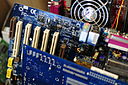
    A computer is a programmable machine designed to sequentially and automatically carry out a sequence of arithmetic or logical operations. The particular sequence of operations can be changed readily, allowing the computer to solve more than one kind of problem. An important class of computer operations on some computing platforms is the accepting of input from human operators and the output of results formatted for human consumption. The interface between the computer and the human operator is known as the user interface.
    Conventionally a computer consists of some form of memory, at least one element that carries out arithmetic and logic operations, and a sequencing and control unit that can change the order of operations based on the information that is stored. Peripheral devices allow information to be entered from an external source, and allow the results of operations to be sent out.
    A computer's processing unit executes series of instructions that make it read, manipulate and then store data. Conditional instructions change the sequence of instructions as a function of the current state of the machine or its environment.
    The first electronic digital computers were developed in the mid-20th century (1940–1945). Originally, they were the size of a large room, consuming as much power as several hundred modern personal computers (PCs).[1] In this era mechanical analog computers were used for military applications.
    Modern computers based on integrated circuits are millions to billions of times more capable than the early machines, and occupy a fraction of the space.[2] Simple computers are small enough to fit into mobile devices, and mobile computers can be powered by small batteries. Personal computers in their various forms are icons of the Information Age and are what most people think of as "computers". However, the embedded computers found in many devices from mp3 players to fighter aircraft and from toys to industrial robots are the most numerous.